
In the mid-1930s, Boy Scouts often camped in what they called “Black Hannah’s Woods” in southeast North Tonawanda. The following scene imagines one such camp meeting, where Hannah’s legend is being told. (Continued from Part 1.)
“The white folk from all over loved to visit Hannah’s little shack in the woods” August continued, repeating the familiar story. “‘Cause she could tell your fortune, and she was always right.”
“Did she use tarrut cards?” Tommy Behring asked.
“Naw, she never needed no cards,” August said. “That’s gypsy stuff. Hannah used tea. She’d pour it thick and black as tar, with the tea leaves floating loose, and make the person drink it down until just a swallow was left, and it tasted something awful. Then she’d take the cup herself, turn it three times in her hands, quick but careful, like she was winding up a clock. She’d tip it over on the saucer and let the last drops run out. When she lifted the cup, Hannah would read the shapes the leaves spelled out. She couldn’t read or write a word of English, but she could read them leaves. If she saw a road, it meant somebody was leaving. A bird meant news was coming. A cross meant sorrow. Sometimes…she even saw a face.”
Little Roggow fidgeted with his pocket knife. August continued in the firelight.
“Now, most times, it was girls who came around, wantin’ to know who they was gonna marry, or if the boy they was moony for was moony back.
“But one day comes along a fine young man from Buffalo. Came down in a big ol’ carriage, hitched his horses to a tree, and struck inta the woods looking for Hannah. He had heard about Hannah’s powers. And he was just at the start of an awful important career. He had a few different young ladies he was courting. He was so full of himself, and he couldn’t wait to see how everythin’ turned out for him. Would he be a successful lawyer, or a real estate millionaire? Would Stella or Flora be his fortunate chosen one? Or even his new girl? How many buildings would his daddy leave him? He had a lot to ask.
“So at first, he has no idea where in creation he is in these woods. Then he smells the sulphur spring and heads north. And all of a sudden, there she is, all alone. Black Hannah! Standing there, with a steaming hot cup of tea in her hands, like she was jes’ waiting for him. There’s chickens in the yard, and birds in the trees, and a broken down old nag out in the pasture, but none of them make a single noise. They just seem like they’re staring at him. Hannah don’t say a word, ‘ither. Just points a finger at a bench made of logs against her cabin, and he sits down in his fine suit. And she hands him the cup to drink.”

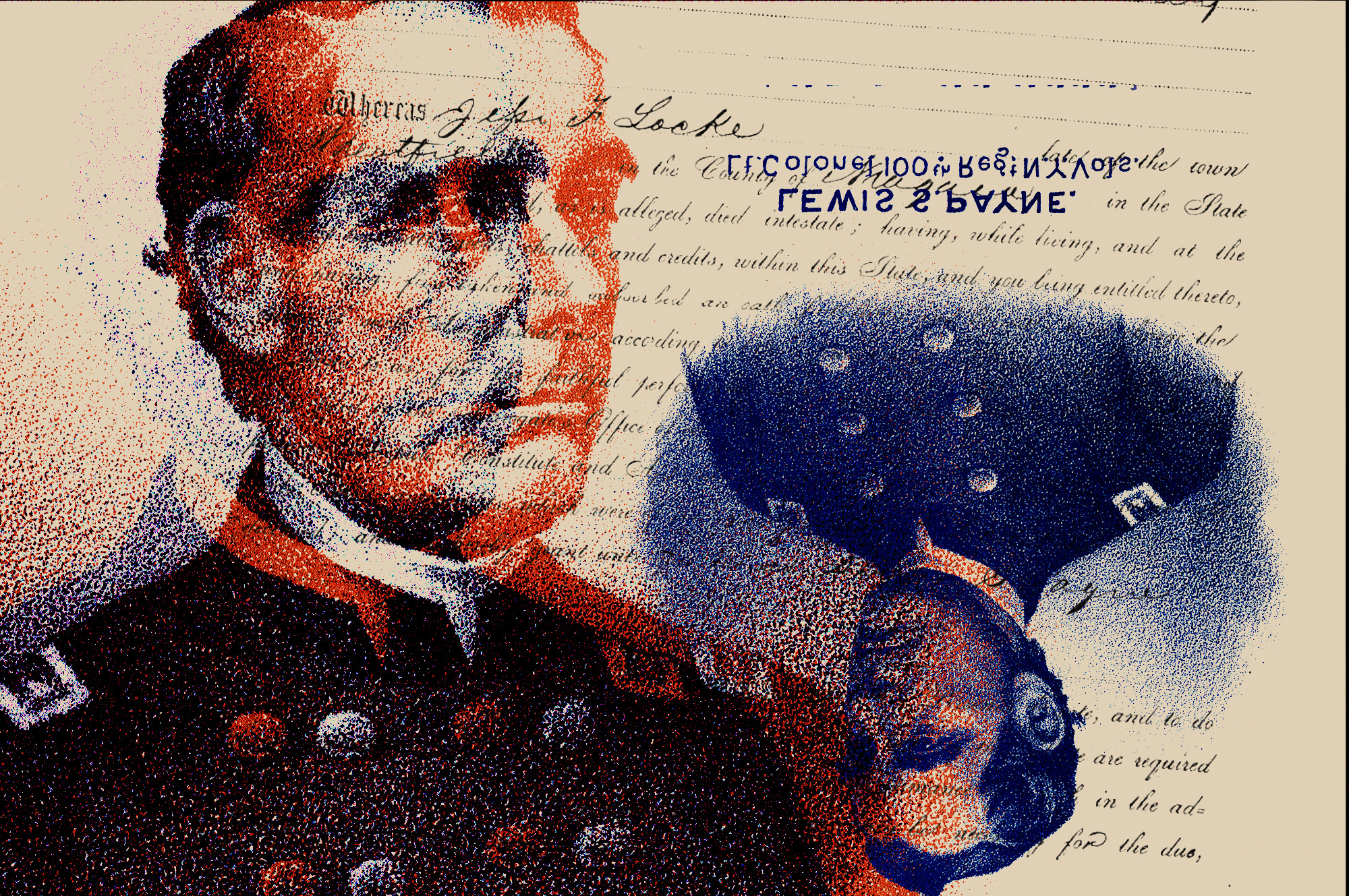
John and Hannah Johnson—a Black couple born into gradual emancipation at the other end of New York State—lived and farmed in the Town of Wheatfield for nearly fifty years, all told. They transformed the swampy, logged-over lot Dr. Jesse F. Locke had sold them into a working farm. But there was a problem: Locke never gave the Johnsons a deed to their land. When the doctor died, a racially charged fight over the Johnson farm erupted. At its center was Locke’s estate administrator, North Tonawanda’s favorite son: the future Colonel Lewis S. Payne.
The Wheatfield Johnsons
John works and votes
The Johnsons were not anti-social recluses living in a shanty in the woods, as later legends would claim. They participated in the economic, social and political life of the community. In addition to managing his own farm, John Johnson had work arrangements with others, hiring out his own team of horses for a time. John Johnson could not read or write, so he hired literate neighbors to keep his accounts, draw contracts and record transactions; one neighbor, Sturgis, served for years as what Johnson himself called his “right-hand man to do my writing for me.” When Johnson is challenged while attempting to vote (likely in the the 1848 U. S. presidential election), Locke puts his word behind Johnson’s eligibility, which rested partially on John’s ownership of at least $250 of land.
Hannah works, cooks and babysits
His wife Hannah cooked at local festivities, and performed domestic tasks for neighbors. She provides advice to those who seek it, and is later remembered as a sort of community baby-sitter. North Tonawanda resident Elizabeth Wherry puts together some of these child’s-eye view remembrances in a lovely 1961 feature:
You went back through the lane at will to visit her, too. A bench made of logs leaned against the cabin, and her horse was tied to a log rail. Black Hannah would see you coming and wave from the door, calling, “Are you hungry?”
You always were, and when you were inside, Black Hannah went to her black cupboard and gave you cup-cakes loaded with maple sugar. Or she might take three steps down to her dug-out cellar, and then you would have cottage-cheese she had made piled thickly on old-fashioned brittle crackers, topped off with salt or sugar. In season, berries were on the fare.
Hannah as fortune teller
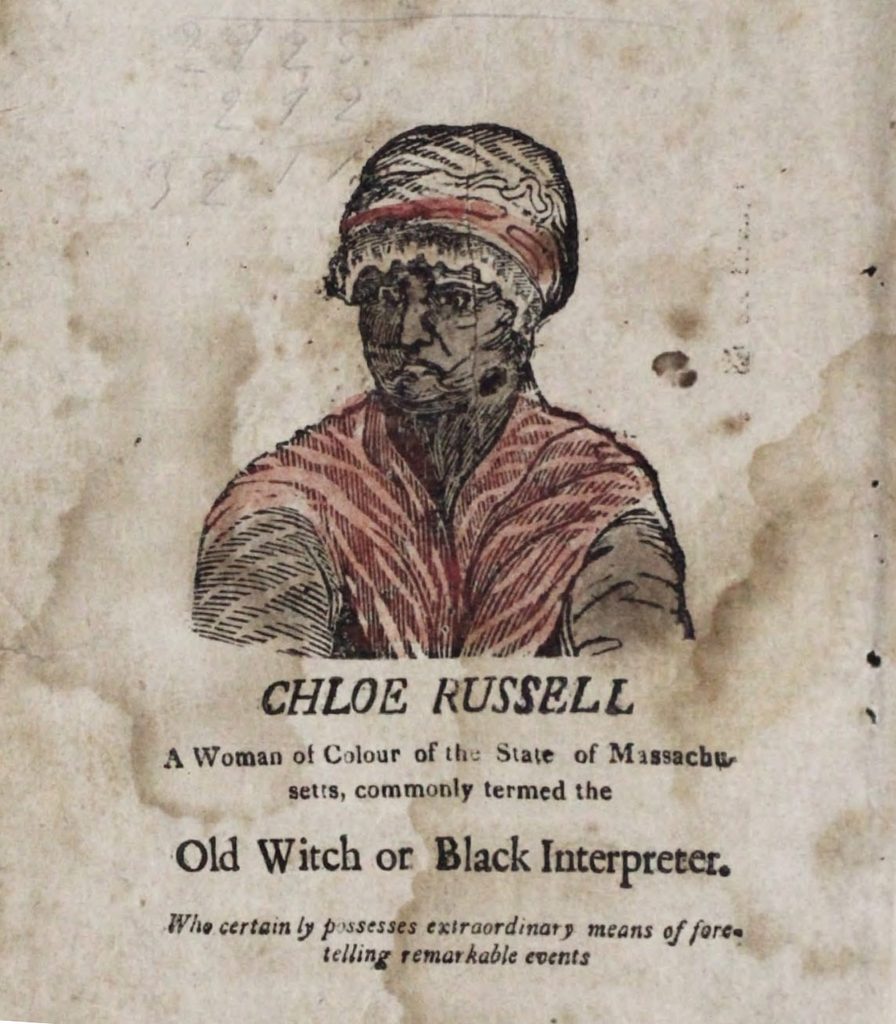
Hannah, of course, is remembered for another skill than maple sugar cupcakes: the ability to see people’s fates. Her purported powers also included the ability to uncover the past lives of her clientele. Later remembrances and oral tradition added to her occult abilities: the reading of tea leaves, knowledge of herbs and medicines, and of course the haunting of “her” woods in the decades following her passing.
Her 1883 obituary says her home “was visited almost every week by dozens of women and young people who had great faith in her powers” (Tonawanda Herald). Multiple newspapers run newspaper stories mentioning her supernatural abilities after her death. The Tonawanda Enterprise notes that for years “there was scarcely a man, woman or child, in all this section of country, that had not known or heard of ‘Black Hannah.’”
Her popularity created problems for Dr. Locke. His daughter Miriam later remembered her father repeatedly telling John he would have to leave if he didn’t “turn people away who came there,” explaining that Locke did not want people “trampling over his grain.” A boarder later remembered Dr. Locke complaining that people were finding fault with him for allowing John to keep “so many black and white folks around him,” and threatened to remove Johnson if he did not “clear them out” (Johnson v. Fonner trial record, 1870–71, New York State Archives).
A role white neighbors recognized
Hannah’s role would have been recognizable to her white neighbors. Black fortune tellers were part of nineteenth-century life, particularly in northeastern cities, but they also became a racial stereotype: the older Black woman endowed with mysterious knowledge, sought out by curious white clients—especially young women asking about love and marriage. By the end of the century, the image had become almost a stock scene in popular art. The stereotype could be patronizing and exoticizing, but it also reflected a real trade in which white customers sought out Black diviners. Hannah may therefore have occupied a role her neighbors already knew how to understand: strange enough to be fascinating, but familiar enough to invite into their social world.
“The fine young man from Buffalo gulps down the sludge in the tea cup, and hands it back to old Black Hannah. And Hannah casts her eyes down nice and calm. She turns the cup three times. She doesn’t say nothing. The Buffalo swell starts asking her, ‘What was it? What do you see?’ Finally Hannah says, ‘I have nothing to say to you.’
“Well the man can’t believe it. Surely she saw the money and great things in his future. ‘Say something, anything, break your silence!’ he screams.”
At this sublimely opportune moment, Cranklin let loose the prodigious fart which had been exerting increasing pressure on his stomach for the last hour. It was a good, long one. The boys yipped and yowled in ecstasy. Cranklin himself enjoyed it most of all, dropping into the wet grass and shaking with laughter.
August glowered.
“I knew you babies ain’t ready for the Hannah stories yet.”
By now the fire was guttering low. Violet flames blistered over the creosote-soaked piles. “Roggow, go on and fetch some more wood! I saw two cord a little ways down the path.”
Little Roggow did not move.
“Unless you’re afraid Black Hannah is gonna come and get ya!” The boys yowled.
Roggow went into the woods alone. He tapped his pockets, left then right, to make sure his knife and rabbit’s foot were there.
Land war
Jesse F. Locke dies without a will
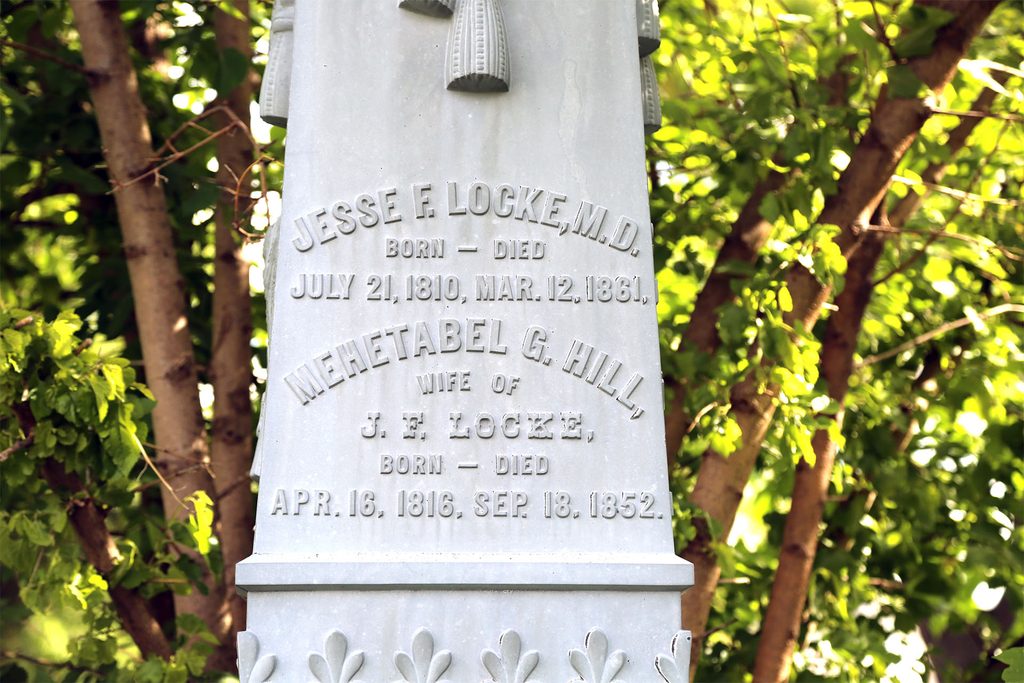
From 1849 to 1861, Johnson worked off the remaining $48 he owed Locke—and then some. Witnesses later testified that Locke repeatedly acknowledged the land was paid for, and promised Johnson a deed. Records show that by the end Locke actually owed Johnson money for additional labor.
But the deed never came. When Dr. Locke died without a will in 1861, at just 50 years old, Locke’s children and heirs begin legal proceedings to sell his property–including the Johnsons’ farm.
And the man who will lead the effort? Locke’s close business associate and North Tonawanda’s favorite son, Lewis S. Payne.
John Johnson, John Chadwick and David Sherman v. John Fonner, Mary Fonner et. al.
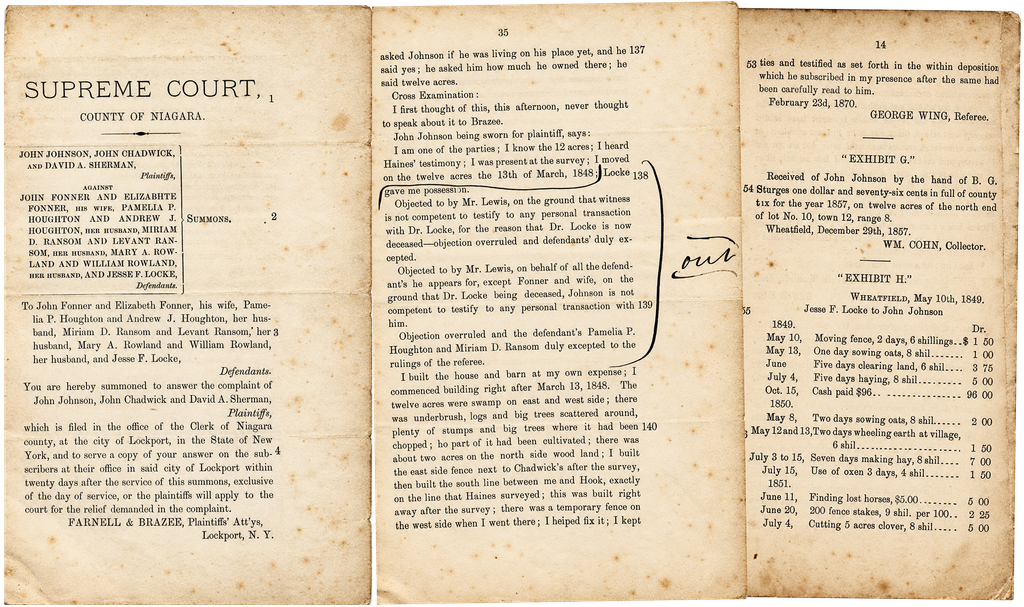
Before I go any further, let me tell you how I know all this.
In the spring of 2026, I began a singleminded, scorched earth email campaign to law libraries, archives, and anyone else with a .ny.gov or .edu email address. My object: to obtain a copy of the complete court packet of an 1870-1879 court case, John Johnson (and later John Chawdiwck) v John Fonner.
I had gleaned from online legal summaries that the case involved John’s and Hannah’s right to be on their land. But these summaries are pretty skeletal. A full court packet, on the other hand, could be stuffed with firsthand testimony.
There were many dead ends. More than one librarian suggested the Johnson packet was probably thrown out long ago. An archivist was sure it was specifically destroyed in the 1911 Great Records Fire at Albany (a cynical voice suggested they bring up that fire a lot when they don’t want to be arsed by the public. You know, “Oh, sorry I can’t lug totes off shelves for you but, you know 1911 Albany fire. Wish I could spend 40 hours digging for manumission papers for you and muck around in all that sweet asbestos, but dol’ dang, I think we been Albany Fired, pardner,” etc. I keep meaning to look up if there was an Albany Fire).
But lo, they delivered the whole enchilada–172 pages of interviews, 12 exhibits, the opinions of multiple courts. I have relied on this trove for invaluable details, and, where plaintiff and defense narratives separate, as they must, I have generally followed the findings of court referee E. G. Sprague. (I have made the entire document available here, even though I personally paid someone at the New York State Archives $44 to scan every page and put it in a PDF. Thanks, Katie.)
Lewis S. Payne (yes, that one) is appointed administrator of Locke’s estate
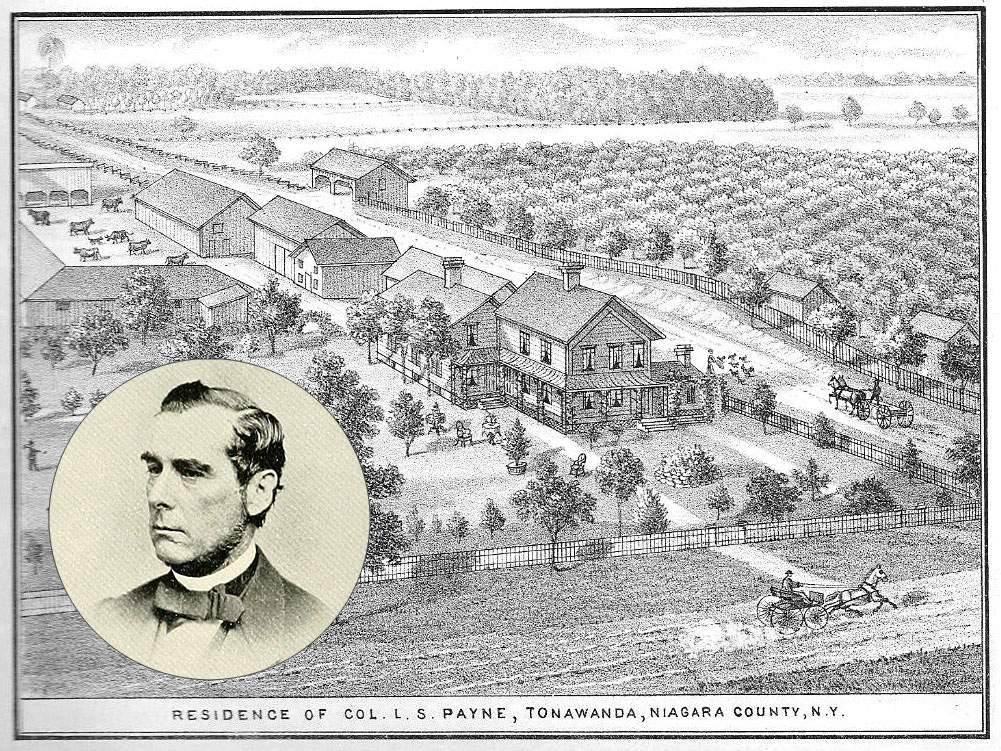
Because Locke did not have a will when he died, the Niagara County Surrogate Court steps in. On April 1, 1861, the court appoints* prominent businessman Lewis S. Payne as the “administrator” of Locke’s estate. His role will be to gather Locke’s assets, settle his debts and accounts, and put his affairs in order for his widow and heirs.
Dr. Jesse F. Locke and Col. Lewis S. Payne had been closely associated for some time. Both were Masons in Tonawanda Lodge No. 247, F. & A.M., and moved in the same Presbyterian circles. They also had substantial business dealings with one another: at Locke’s death, each man owed the other money.
It should be noted that we don’t know to what extent Payne was acting on Locke’s understood but undocumented wishes, Locke’s widow’s specific direction, or of his own volition. But some of what happened next went well beyond the court-appointed work of settling Locke’s personal estate, and presents North Tonawanda’s Civil War hero in a most unflattering light.
*We do not know if Payne petitioned the surrogate court or if his name was put forward by Locke’s heirs.
Payne slashes the Johnson farm to a single acre
In April 1861, just weeks after Dr. Locke’s death, Lewis S. Payne walked onto the Johnson farm. With him were Locke family friend Peltiah Hill and one Eli De Rapelyea.
John was out in his yard. Hannah stood in the door of their house.
Mr. Payne was not there to socialize. He asked John if he had the deed for the farm. Of course, Locke never gave the Johnsons a deed. John said he did not.
“Locke is dead, and there are new laws,” Payne told him, John would later testify. Payne then ordered his man De Rapelya to move in the Johnsons’ line fence, as Payne himself grabbed John’s axe and drove new stakes. When the men were done, they had shrunk the boundaries of the Johnsons’ farm: down to about a single acre around the house, barn and fruit trees.
“That’s enough for the niggers,” Payne said to Hill, Hannah would later testify.
The Johnsons were told that they may stay temporarily, until they find another place to live. De Rapelyea finished setting the new fence boundaries later that day, separating the Johnsons from the land they had worked for about twenty-five years.
Payne denied using the racial slur, saying anything about “new laws,” or driving the stakes himself. But there is not much dispute about what actually happened to the land: De Rapelyea was installed on the Locke farm by Payne and took possession of the Johnson tract except for roughly one acre surrounding their house. The old fence was taken down and its rails used to enclose the smaller parcel. De Rapelyea then worked and farmed the remaining acreage for the next two years.
Payne and the Locke family had reduced the Johnsons’ land to just one acre. But they needed more than moved fences. They needed a paper trail that would hold up in court. While Lewis S. Payne was busy being captured in the Civil War, his son and associates would carry on the campaign against the Johnsons.
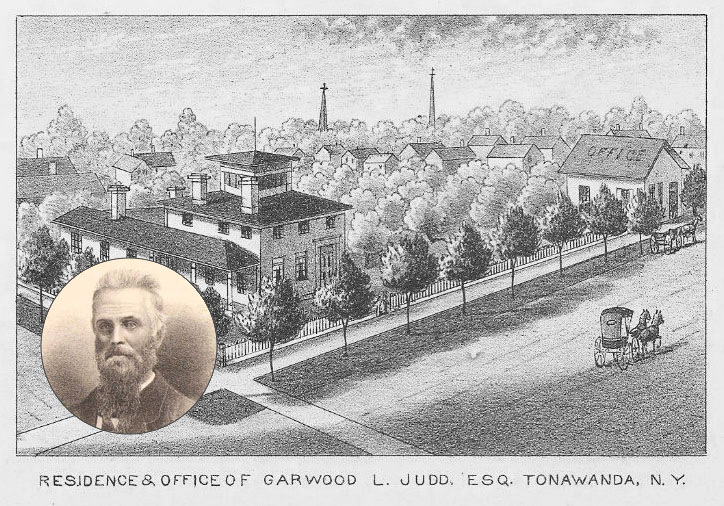
The ambush at Garwood L. Judd’s Office
“Stronger than common whiskey”
On April 24, 1863, Locke family friend Peltiah Hill (who was with Payne in the scene described above) came in his wagon to the Johnson home. He asked John if he wanted to grab a drink at a local tavern. John agreed.
John would later testify that what he had been given to drink was “stronger than common whiskey.” He was soon confused, reeling from the drink, and unable to think straight. Then Hill made a strange announcement: they were going to the office of local lawyer Garwood L. Judd to settle Johnson’s claim against Locke’s estate.
Johnson had visited lawyer Garwood L. Judd the year before to submit his receipt for the $96 down payment to Locke, and the running tally of work showing he had paid for the land several times over. So although this meeting was unplanned and unexpected, Johnson thought Judd would be there to represent him and protect his interests.
Lewis Payne sends in his son
However, Judd was not there. There instead were Aaron Eggert, a local attorney John did not know, and Eugene Payne, Lewis’s 20 year-old son who had been left in charge of settling Locke’s estate while Lewis was at war.
It was instantly clear that this was an ambush meant to pressure Johnson into signing away the rights to his land. Eggert and Payne claimed the original purchase price was $30 an acre, not $12 as John had maintained (it does not appear the purchase price was in the receipt). They figured in interest, they added rent. When they were done, Johnson had nothing.
Johnson would later testify: “I was bewildered: I didn’t say anything in the office; couldn’t.” Eggert remembered John weeping, and protesting he was being wronged. John was scared, wanted his papers, and wanted to go home. Peltiah Hill allegedly told him he could not “have the papers and the land too.” John sat down again.
Payne said he could stay on the premises for ten months and receive $10 if he signed. But when he was threatened with jail if he didn’t sign, John finally left.
The Johnsons stand their ground
In spite of this pressure, the Johnsons remained in their home. After De Rapelyea, another tenant, Gentz, took over. But John moved the fences back to their original boundaries, and told Gentz he was not permitted to work the tract: that this was his land.
The Locke Estate sells out
In the spring of 1868, Dr. Locke’s heirs sell about 62 acres of land (including the Johnsons’ twelve acres) to the John and Elizabeth Fonner family. John Fonner was surely aware the Johnsons lived there. Everyone knew. But he also knew that John and Hannah Johnson did not have a paper title. He was willing to take his chances against the Johnsons in court, if it came to it.
But he didn’t count on John Chadwick.
The Johnsons goes to neighbor John Chadwick for help
When the land was sold to the Fonners, John and Hannah Johnson knew they had to act quickly to keep from being dispossessed. They enlisted the help of longtime neighbor and farmer John Chadwick. Chadwick was not a lawyer, but he knew his way around the legal system, and he had resources. The Johnsons brought him the legal notice they received on April 1, 1868.
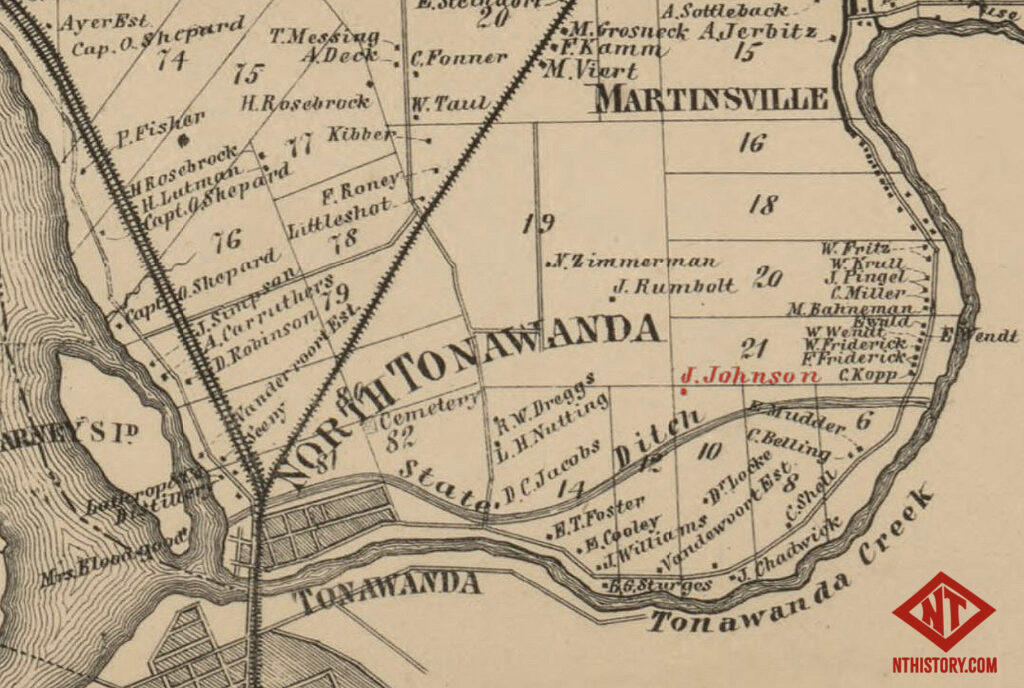
Chadwick also had a personal interest in Fonner’s purchase. He owned adjoining tracts in the same Lot 10, purchased from Locke in 1853 and 1857 (seemingly without any difficulty obtaining a deed).
There appears to have been some personal animus between Chadwick and Fonner. Chadwick later testifies that Fonner, who had been drinking, tells him: “I have bought Locke’s farm and I will make you a present of the two niggers.” Chadwick answers that Fonner will discover that the “colored man has as many friends as you.” Fonner reportedly responds: “I will give you all the law you want” (fols. 367–69.)
Battle in New York Supreme Court in Niagara County
John Fonner proved true to his word. Having pledged to give Johnson and Chadwick “all the law they wanted,” he helped turn the twelve-acre farm in the northwest corner of Lot 10 into a ruinously expensive legal war. John and Hannah Johnson, with John Chadwick at their side, fought the Fonners through affidavits, referees, appeals, and costs that soon totaled more value than the land could repay. By 1878, even the local paper had reduced the struggle to its bleak arithmetic: “the only question now” was “who will be the greater loser eventually?” (The Herald [Tonawanda, N.Y.], April 18, 1878.)
Roggow stomped away from the fire reluctantly, fetching more wood as August had asked. Instantly the air was cold on his face and knees. He walked faster to stay warm, looking down at his lucky rabbit’s foot and his feet, following the path. The sound of the conversation by the fire disappeared. He smelled a sulfur smell, like a struck match, or a rotten egg from the henhouse. His thoughts drifted off as he let his feet walk. To think that old Black Hannah had lived out here years before. It seemed like such a lonesome place now. But his dad said a farm could become covered with woods in the lifetime of just one person so heavy you wouldn’t believe it had been touched since the dawn of time. Left or right or straight? He blinked his eyes hard. He thought he saw fire glinting through shadows of elms. But…this wasn’t their campfire. He saw headlights: he must be near the road. How far he had wandered! Some men jumped out of the truck and Roggow instinctively ducked behind a tree. He peered through the leaves. His breath stopped in his chest. He could see men in strange white clothes, like pajamas. They were around a fire. No, it was too hight to up to be a fire. It was…a cross, burning high against the trees. The cross looked like a man on fire, arms reaching out.
Roggow turned around and ran with blind terror back through the woods, squeezing the rabbit’s foot for all it was worth. He became aware he was crying. He ran and ran until he could hear the scouts again. They were singing a song he had sung with them many times. But it sounded different now, from outside the circle.
God gave Noah the rainbow sign
Don’t you see?
God gave Noah the rainbow sign
Don’t you see?
God gave Noah the rainbow sign
No more water, but the fire next time
Hide me over, Rock of Ages, cleft for me.
NEXT TIME: PART 3: “Sundown Town.”
Leave a Reply