

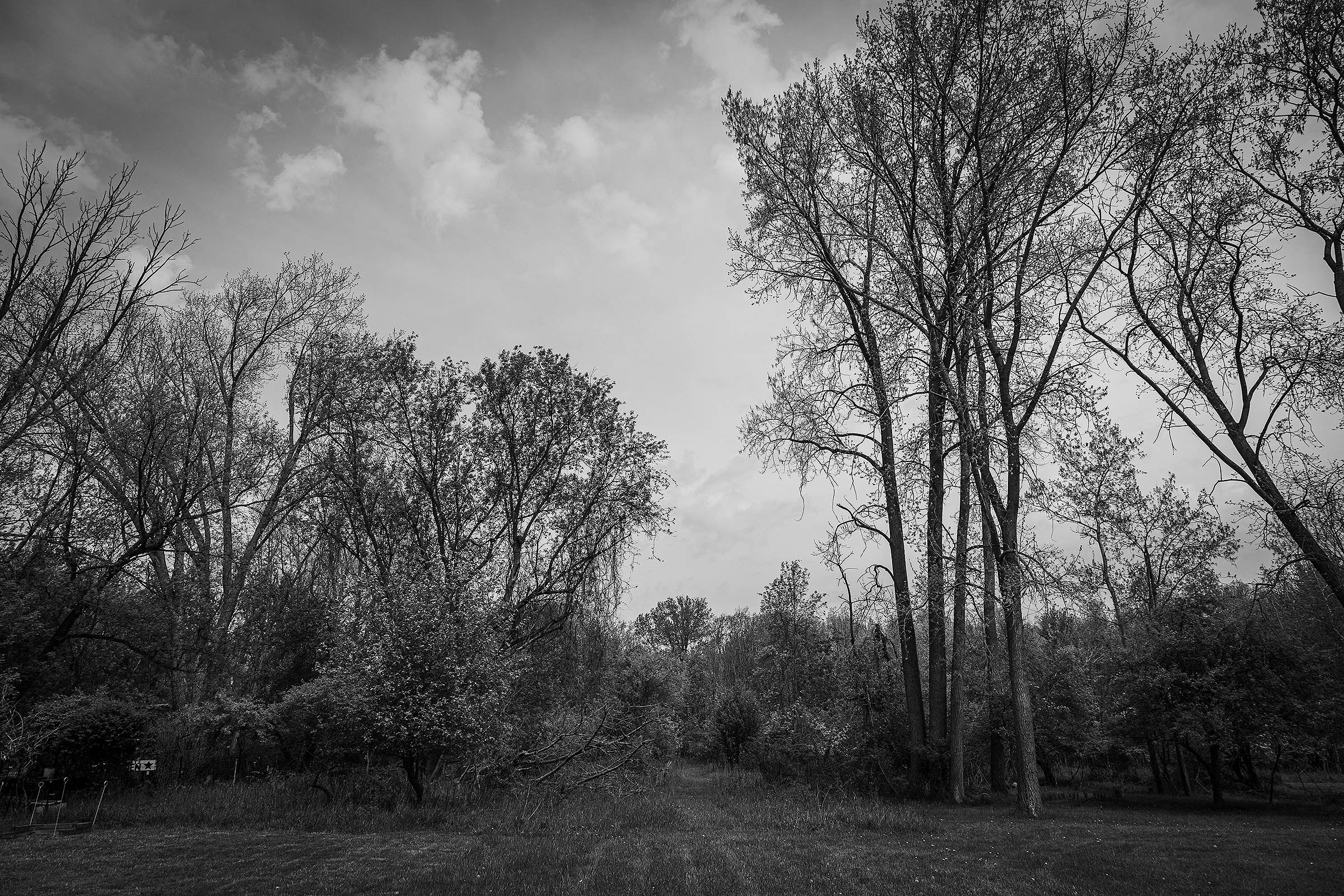
In the mid-1930s, Boy Scouts often camped in what they called “Black Hannah’s Woods” in southeast North Tonawanda. The following scene imagines one such camp meeting, where Hannah’s legend is being told.
Once it left the fire, the light died fast. It painted the boys’ rapt faces and bare knees a sinister red-orange, traced a sawtooth pattern across the neat row of tents at the edge of the clearing, and vanished just inches into the thick ring of elms.
The last laughter had scarcely died away when a collective hush asserted itself. August, Troop 73 scout leader, recognized his moment. He loosened the knot of his neckerchief and paused for effect.
“You boys know why they call these Black Hannah’s Woods, don’tcha?”
The other boys froze. The air stopped moving.
”Aw, Black Hannah’s bunk!” Cranklin from Troop 1 finally offered weakly, his hands worrying his walking stick. “Ain’t no such thing as ghosts. Only babies believe in ghosts.”
August waited.
“C’mon Cranklin, I wanna hear,” the little Roggow boy from Troop 88 wheezed. “Wasn’t she an old colored lady that read tea leaves?”
August looked around at the flickering red light in the eyes of the other boys. “That ain’t the half of it.”

Around campfires and at sleepovers, under stars and under covers, previous generations of North Tonawanda children heard the tale of “Black Hannah”—an old Black fortune teller who, according to legend, lived alone in a shack in the deep woods of Wheatfield, outside the village of North Tonawanda, around the Civil War era. Hannah was said to have escaped slavery in the South. After her death, strange flowers reportedly sprang up around her shack, and her spirit was believed to haunt the surrounding forest. The place became known—and feared—as “Black Hannah’s Woods.”
But Hannah was a real person. In this three-part series, using newly uncovered records from the New York State Archives and other sources, we will recover the woman behind the ghost story. Hannah’s life, as it turns out, was remarkable enough without haunted woods, ominous crows or moaning trees—though they do lend a certain Gothic charm. And the woods themselves would prove to be more than scenery: Hannah and her husband would spend years fighting to keep the small piece of them they called home.
Before she was a whispered legend, Hannah was a Black girl born into the uneasy aftermath of slavery in the Hudson-Mohawk world—a servant in the household of the most powerful man in New York State.
Hannah’s early life
Surviving in the aftermath of slavery
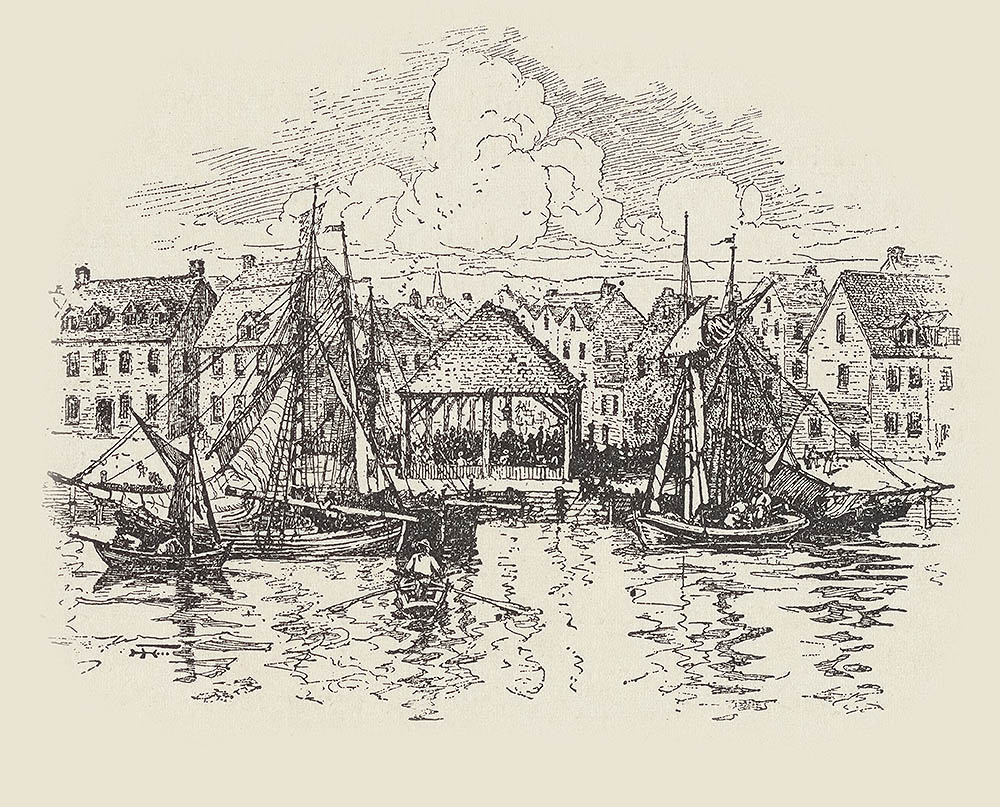
Hannah—we do not know her maiden name—was born in Albany County, New York, around 1803. She entered the world in the strange half-freedom created by New York’s Gradual Abolition Act of 1799. Under that law, Black children born to enslaved mothers after July 4, 1799 were not enslaved for life, but neither were they free in any meaningful sense. Black females remained bound servants until age 25; males until 28.
Serving in the house of the governor
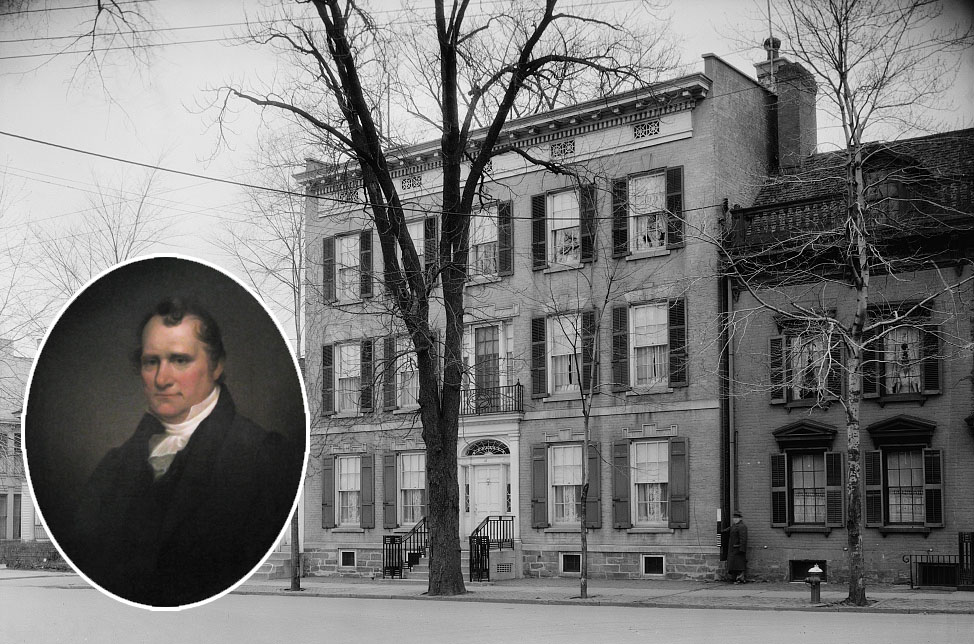
According to her obituary and her own sworn testimony, Hannah was raised in the household of Joseph Christopher Yates of Schenectady. During Hannah’s girlhood and young adulthood, Yates served as mayor of Schenectady, New York state senator, New York Supreme Court judge, and finally governor from 1823 to 1824. Hannah learned German while growing up in the household of Governor Yates. Years later, the language would serve her well when she settled among the German and Prussian farmers of Wheatfield.
As a member of the Yates household, Hannah’s girlhood and young adulthood placed her unusually close to the rituals of state power. She likely listened from the edges of rooms where judges, senators, governors, college men, canal boosters, and visiting dignitaries passed through. In 1825, when Lafayette came through Schenectady during his triumphal return to America, he called upon Governor Yates; if Hannah was still attached to the household, she may have been near enough to witness the machinery of public honor from the servant’s side of the room.
As a member of the Yates household, Hannah’s girlhood and young adulthood placed her unusually close to the rituals of state power.
Freedom on paper
If Hannah was born around 1803, she would have become legally free around 1828 at the latest. But legal freedom was not social equality. In Schenectady, for Black women, that “freedom” often meant domestic service, washing, cooking, childcare, or continued dependence on the households where they had served. Schools, skilled trades, property, and public authority remained difficult to reach. Some looked westward, toward canal towns, port cities, and frontier settlements, where opportunity might be rougher but less fixed.
Hannah’s husband: John Johnson
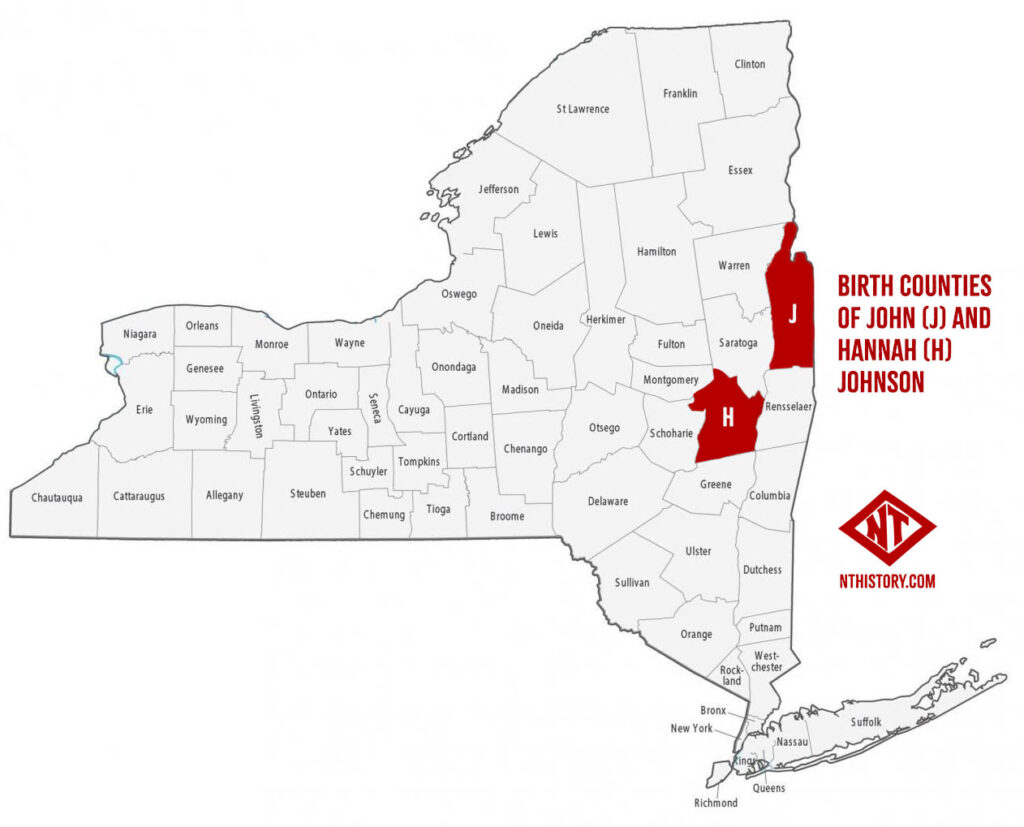
Although he is not mentioned in the later legend, Hannah had a real-life husband. His name was John Johnson. John was a Black man born around 1808* in New York State’s Washington County: just about 40 miles northeast of Hannah and the Yateses.
It appears that John, like Hannah, was born into New York State’s Gradual Abolition. For men, bound servitude lasted until age 28, meaning John could be indentured until as late as 1835.
* Census records place John Johnson’s birth anywhere from about 1797 to 1808, but in court he gave his own age as “nearly sixty-two,” pointing to about 1808. Hannah’s records are no steadier: the census gives birth years from about 1803 to 1821, though the 1850 census and her death records make about 1803 the best working date.
John comes west to the shores of Lake Erie
John seems to have served the James R. Peters family of the town of Cambridge, Washington County, New York. Around 1826, shortly after the opening of the Erie Canal, the family comes to the town of Evans, south of Buffalo, near Lake Erie. John would have been about 18.
For all the evils of the institution that initially brought them together, it appears John Johnson had a good relationship with the Peters family. Even after his period of indentured service was over and he had struck out on his own, Johnson would return to visit the Peters family, as late as 1857.
It is still unknown when John and Hannah met and were married. But by 1840, according to that decade’s U. S. Census, John and Hannah are finally free of the lingering bonds of Gradual Abolition, and living in the Town of Wheatfield.
CONTINUED: A scene imagined from the historical record.
“Hannah came here from the South with a whole gang of slaves.” August recited the story more or less as he had heard it. “Meanest bunch of lying curs you ever saw. The lot of ’em set up camp by the creek and looked to be making themselves at home. Well, the white folks here weren’t having none of that. One night they got a posse up and rode down to the creek. Burned their cabins. Cut the horses loose. Threw all their belongings into the water. Chased the whole crowd clear to Canada.”
The fire snapped.
“My grandpa was one of the riders. Couple of ’em wouldn’t go peaceably. Nobody would ever say what happened to them. But years later, when they were putting in new sewers… they found a whole mess of human bones.”
“What about Hannah?” Cranklin asked.
“Cranklin, you gonna let me tell the story, or you wanna run your fool mouth all night?”
Cranklin looked down.
“Like I was tryin’ to say,” August said. “Hannah was allowed to stay. She built herself a hut at the edge of the woods, where she lived all alone. There was a sulphur well nearby. Some say that’s where she got her strange powers from—”
The Roggow boy frowned. “Why’d they throw their things in the creek? They weren’t hurting nobody, sounds like.”
The other boys looked toward August.
August didn’t seem to understand the question.
The Johnsons in Wheatfield
A place of fellowship
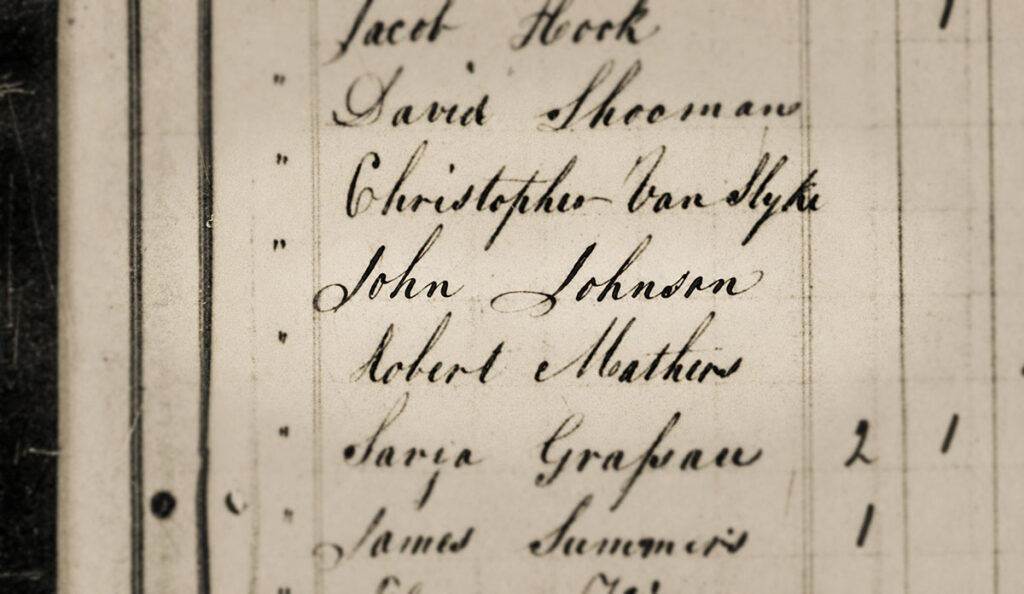
The first clear record of the Johnsons in this area appears within the 1840 U.S. federal census for the Town of Wheatfield.
It shows three free Black people in John Johnson’s Wheatfield household: a man and woman between twenty-four and thirty-six (almost certainly John and Hannah) and an older man somewhere between fifty-five and one hundred. All three were listed as farmers.
Later censuses show the Johnsons often had people staying with them. In 1850, four other adults shared the Johnson home: Henry Hall, a Black man born in Virginia; Joseph Polly, a Black man born in Canada; Ann Polly, born in Ireland and ambiguously recorded as “white or mulatto”; and Stephen Smith, a Black man whose birthplace was not given. In 1860, their household included Isaac and Clarissa Davis, both Black and born in New York, and a one-year-old Black child, Dennis Colens. The census returns show a household whose doors repeatedly opened to people beyond the married couple. They do not tell us why those people were there.
Underground railroad connection?
Given the Johnsons’ proximity to Canada—and the documented Underground Railroad activity in Niagara Falls, Lewiston, Cambria and elsewhere in Niagara County—it is natural to wonder whether they helped freedom seekers. A 2012 survey of Niagara-area sites even included the Johnson home as a possible safe house. But the survey itself said only that John “may have escaped” slavery and that the couple “may have used” their home in the Underground Railroad. Its case rested largely on twentieth-century oral tradition and on questions raised by the census—not on any contemporary record. More recent research has also overturned several of its assumptions: Hannah was born in bondage in New York, John was born in Washington County, New York, and both were living openly as free people of color in Wheatfield by 1840.
To date, no contemporary evidence has surfaced linking the Johnsons to the Underground Railroad. No newspaper account, court record, abolitionist memoir, fugitive notice or family testimony identifies their farm as a station or either Johnson as a conductor. The secrecy of the Underground Railroad makes such evidence difficult to find, but difficulty is not evidence. The people living with the Johnsons may have been relatives, boarders, farmhands, tenants, families between homes or travelers staying for a season. Some may conceivably have been freedom seekers; the census simply cannot tell us.
Whatever role they did or did not play in the Underground Railroad, John and Hannah clearly created a place of work, fellowship and welcome. The Johnson farm was a rare Black social nexus in overwhelmingly white Wheatfield, one that repeatedly made room for other Black adults and families. That hospitality would later draw the notice of white neighbors—and become the pretext for threats and some genuinely vicious behavior.
The Johnsons on Lot 19
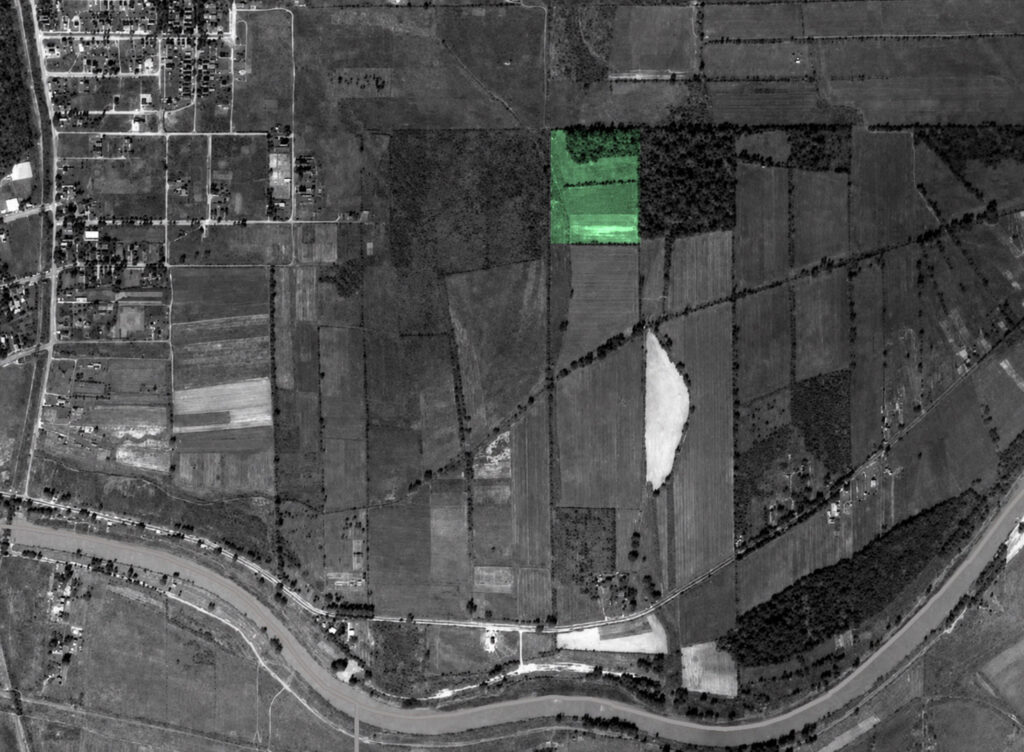
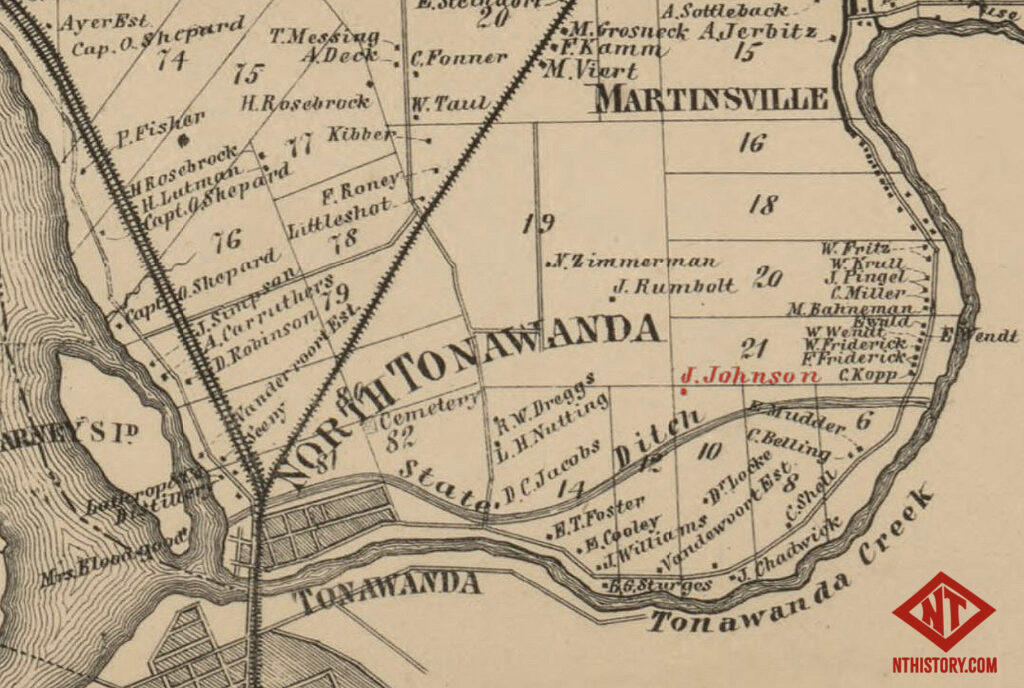
It has long been known that Hannah Johnson lived on Lot 10 at the end of her life. New evidence suggests that when the 1840 census enumerator came calling, they may have been living in a different location: a log house in the vicinity of present-day Roncroff Drive and Park Ave. According to later court testimony, until about 1848, John held 23 acres on Lot 19, subdivision 6 of Wheatfield, and his log house was a mere 40 rods (1/8th of a mile) north from where they would later live.
While living on Lot 19, Johnson was doing farm work for an area physician who lived nearby: Dr. Jesse Fayette Locke. This Dr. Locke will play a pivotal role in the Johnsons’ life. His seeming carelessness which will plunge the Johnsons into a fight for their land.
Dr. Jesse F. Locke
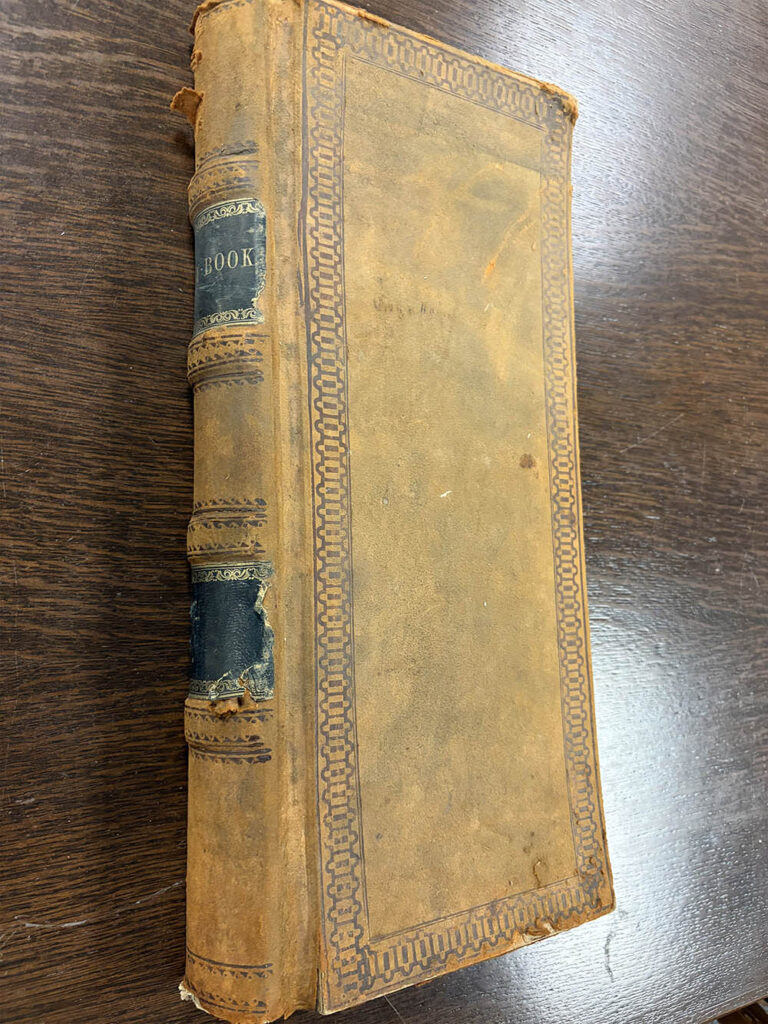
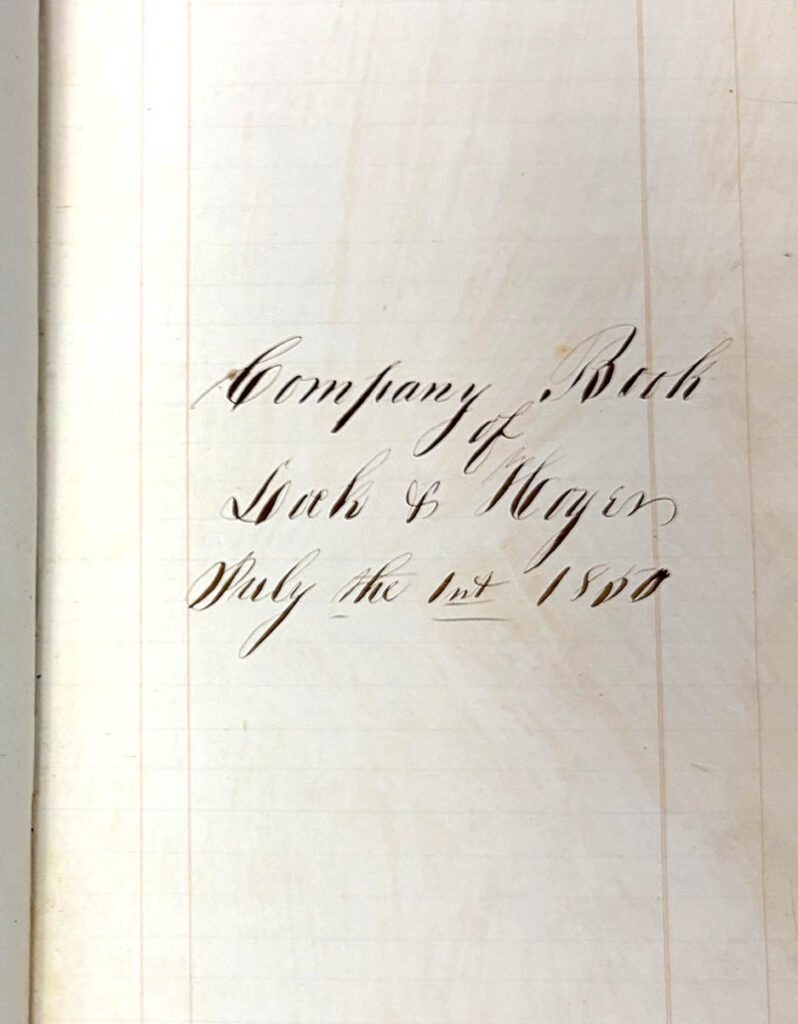
Robert L. Brown History of Medicine Collection, University at Buffalo.
Dr. Locke had studied medicine in Maine, and is considered the first resident physician of the Tonawandas. He arrived in the area about 1838, at the age of 28.
Frontier medicine at the Niagara Hotel
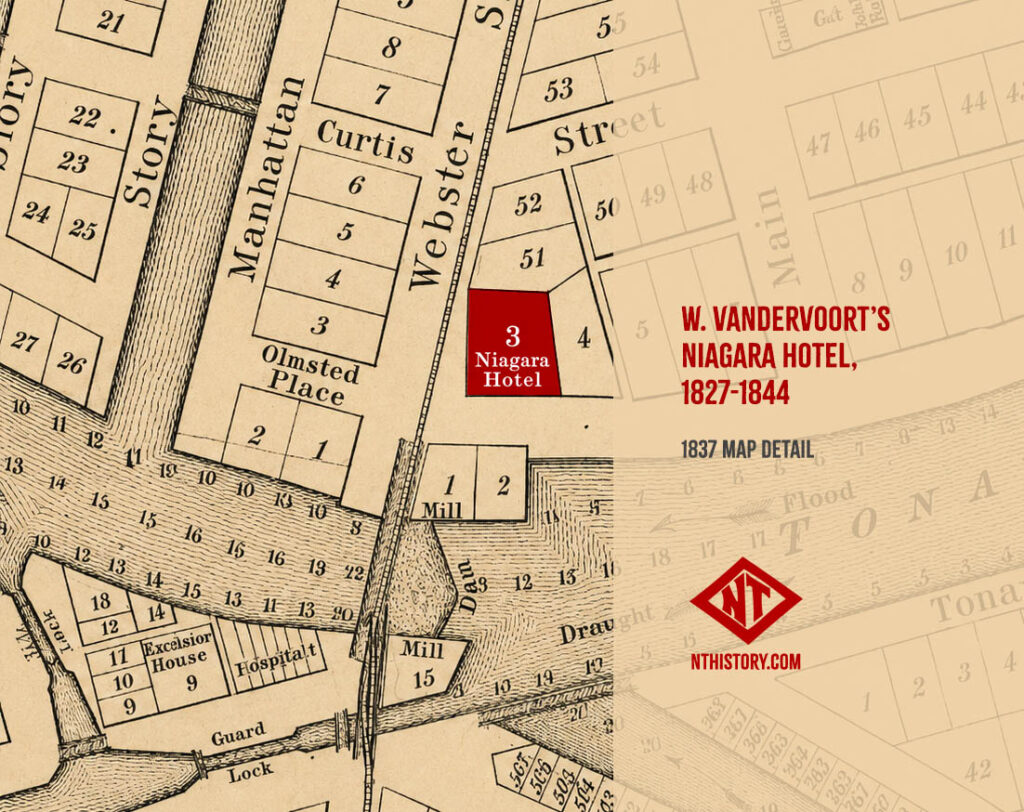
The young Dr. Locke evidently had a colorful side. In December 1842, Locke was called from his “comfortable bed” to the former Niagara Hotel, where the Sweeney Building stands today, to attend a man said to be dying of “spasmodic convulsions.” The patient, Harriott, had been arrested for theft and was now floundering on the tavern floor, beating his head against the walls, and performing every symptom available to a man suddenly interested in medicine. Locke approached the thrashing suspect and received a violent kick. The doctor checked the pulse, and finding nothing out of the ordinary, immediately proceeded to treatment. He ordered the man up and “administered a few cuts” with his riding whip. The cure was miraculous. Harriott jumped up at once and announced, “Doctor, I feel much better.” Such, apparently, was the efficacy of frontier medicine.
Locke later pleaded guilty to assault and battery in Buffalo.
“It was the first time,” said the doctor, addressing the court, “that I ever prescribed such medicine, and though not strictly within the school of pharmacy, I trust your Honor will attribute the offence to a desire to promote the advancement of the science.”
“A Singular Case,” Boston Cultivator, March 4, 1843, p. 68.
Locke was fined just six cents — a fine the amused district attorney volunteered to pay.
Locke and Johnson strike a land deal
By 1844 Dr. Locke had acquired nearly all of Great Lot 10, but by 1848 he is looking to sell. John agreed to buy 12 acres of in the northwest corner of Locke’s land at $12/acre, about $144, to be paid “as he could in work, produce, or anything of that kind.” John sold his Lot 19 property, and set to building on the new lot immediately.
The Johnsons on Lot 10
Frame house and barn
On March 13, 1848, the Johnsons took possession of their new property, erecting a house and barn at their own expense. The house was later described as a frame house of hewn timber, boarded, with battered doors, two or three windows, one partition, no lath or plaster, and a shingled roof. The barn was also later said to be of frame hewn timber, boarded, with a shingle roof.
The tract is professionally surveyed that fall, on November 11, 1848. It is ten chains wide by about twelve chains forty links deep. John Johnson builds or updates the boundary fences himself.
Down payment and contract
On October 15, 1849, Dr. Locke and John Johnson convene at the home of Justice Thomas J. Keith to finally put their handshake deal into writing.
John Johnson produces a bag of $96 in coin (the proceeds from the sale of the Johnsons’ Lot 19 property), and asks Justice Keith to count it. Hannah will later describe the bag’s contents: “It was half dollars, dollars and two shilling pieces; some Mexican dollars; principally half dollars.” That payment left a balance of $48 on Johnson’s account with Dr. Locke.
John Chadwick
Also present at the transaction was local farmer John Chadwick. Chadwick was another of Dr. Locke’s resident labor men. He would also soon buy adjacent strips of Dr. Locke’s Lot 10, and come to play a pivotal role in the Johnsons’ lives.
A “dreadful” place
The property which Dr. Locke sold to the Johnsons was not so much a neat little starter farm as it was the stripped remainder of a woodlot. Hannah Johnson will later recall:
[The] land was a dreadful place when we went on—[full of] water, briars and logs.”
The valuable timber had already been taken, except for roughly an acre and a half left standing in the northeast corner. What remained was not “cleared land” in the useful agricultural sense. It was a logged-over mess: tops and logs lying where they fell, stumps everywhere, rubbish, underbrush, and trees still standing only where they had not been worth taking. The land was wet, unditched, wild and partly swamp, with water draining down from the higher ground to the north.
From waste to homestead
After the house and barn were built, John and Hannah had plenty more work to do. Like early homesteaders all over the country, the Johnsons used the one asset they could count on: their labor. Together they cleared through underbrush, logs, stumps, big trees and rubbish. They worked wet ground and drained water off it. They raised crops, pastured the land after the crops were off, and cut firewood from the dried timber and dead wood left in the remaining woods. John fixed the temporary west fence, built the east fence next to Chadwick, straightened the south fence onto Haines’s surveyed line, and built the north fence with Cuff. He kept the fences up year after year. He set out twenty-one apple trees, five cherry trees and two peach trees. Around all this was the daily work of home: cooking, washing, gardening, preserving, tending animals, stretching food and fuel through the seasons.
How Hannah found time to read tea leaves is anyone’s guess.
Next time: Dirty deeds


Leave a Reply